Projects
Interannual Variability of the Mid-Atlantic Bight Cold Pool
The interannual variability of the Cold Pool with regard to its persistence time, volume, temperature, and seasonal along-shelf propagation is investigated based on a long-term (1958–2007) high-resolution regional model of the northwest Atlantic Ocean.
- A Cold Pool Index is defined and computed in order to quantify the strength of the Cold Pool on the interannual timescale.
- Anomalous strong, weak, and normal years are categorized and compared based on the Cold Pool Index.
- A detailed quantitative study of the volume-averaged heat budget of the Cold Pool region (CPR) has been examined on the interannual timescale.
- Results suggest that the initial temperature and abnormal warming/cooling due to advection are the primary drivers in the interannual variability of the near-bottom CPR temperature anomaly during stratified seasons.
- The long persistence of temperature anomalies from winter to summer in the CPR also suggests a potential for seasonal predictability.
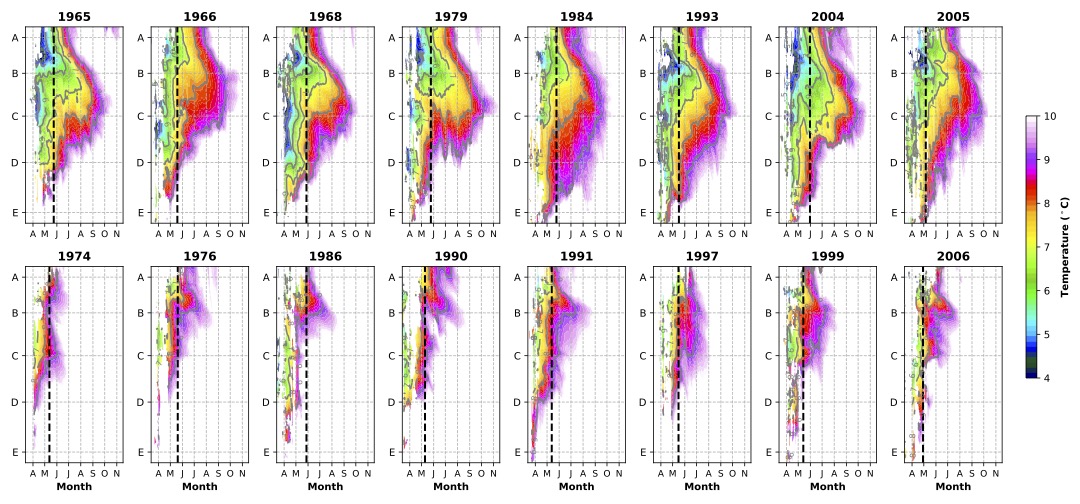 Figure. Comparison of along-shelf distribution of the Cold Pool minimum temperature between strong (upper eight panels) and weak (lower eight panels) Cold Pool years. A—Nantucket Shoals, B—Montauk Point, C—Sandy Hook, D—Delaware Bay, and E—Chesapeake Bay. Figure Source
Check out the paper here›
Other Projects
- Projects · Projecting future changes in the Gulf Stream warm-core rings and their impacts on the Northeast U.S. Large Marine Ecosystem in a changing climate using regional MOM6 simulations
- Projects · Skillful multiyear prediction of marine habitat shifts jointly constrained by ocean temperature and dissolved oxygen
- Projects · Seasonal Prediction of Bottom Temperature on the Northeast U.S. Continental Shelf
- Projects · Interannual Variability of the Mid-Atlantic Bight Cold Pool
- Projects · Long-term SST Trends over the Northwest Atlantic Shelf & Slope
- Projects · Seasonal Variability of the Mid-Atlantic Bight Cold Pool